Emerging/Sharing
An unsolicited weather report and some recent writing
The start of the year looked like this, providing a scenic counterpoint to societal collapse:
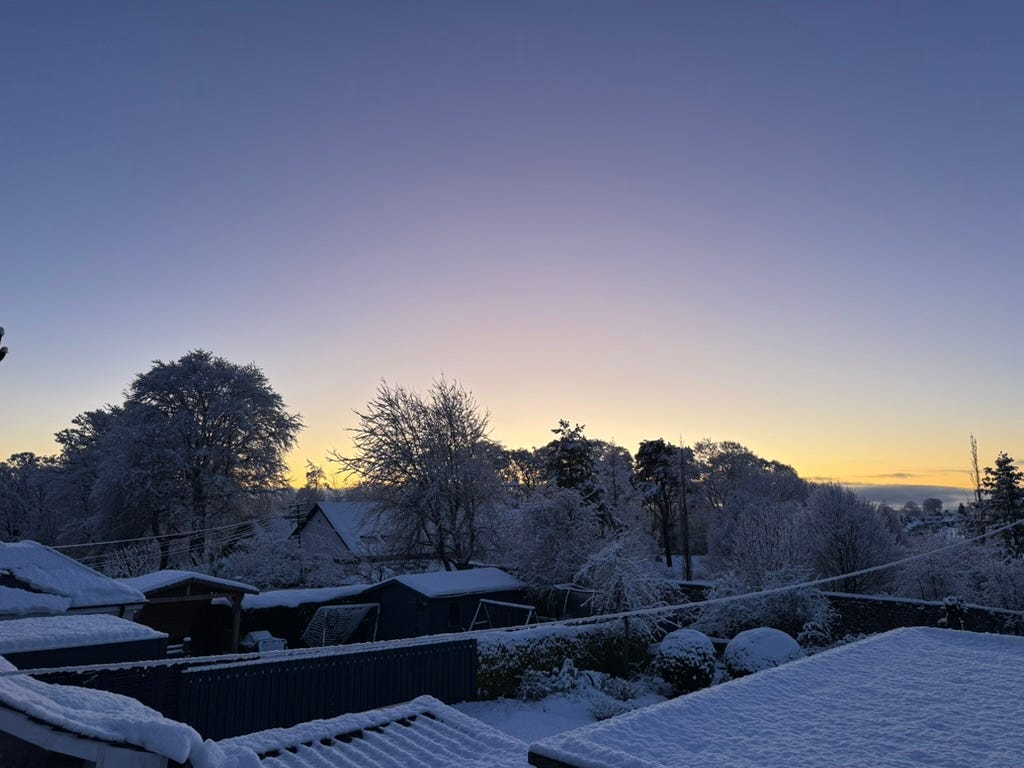
Then the weather turned to shit, and the past month has had a more fitting backdrop of wild winds, torrential rain and zero sunlight. It’s been utterly miserable.
I went down to the coast on Friday for the first time in weeks. It looked like this:
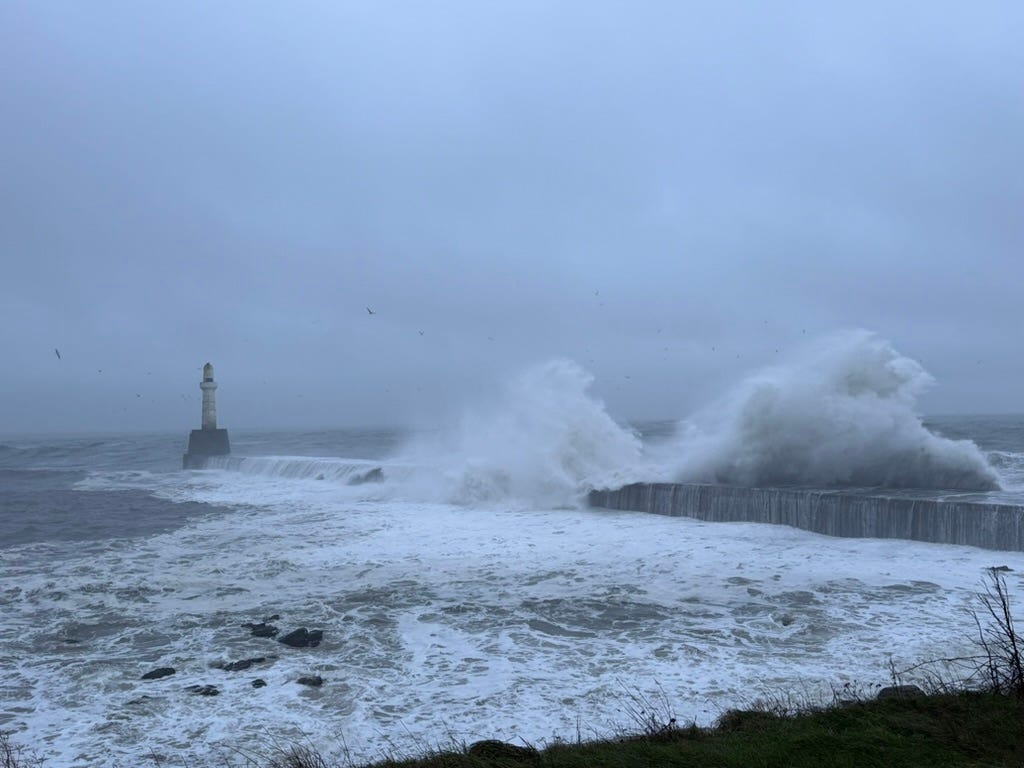
Then today we witnessed a very small patch of blue sky emerging from behind the clouds. I was genuinely excited to see it, so grim has this last month been. Hopefully there’s more blue sky on the way.
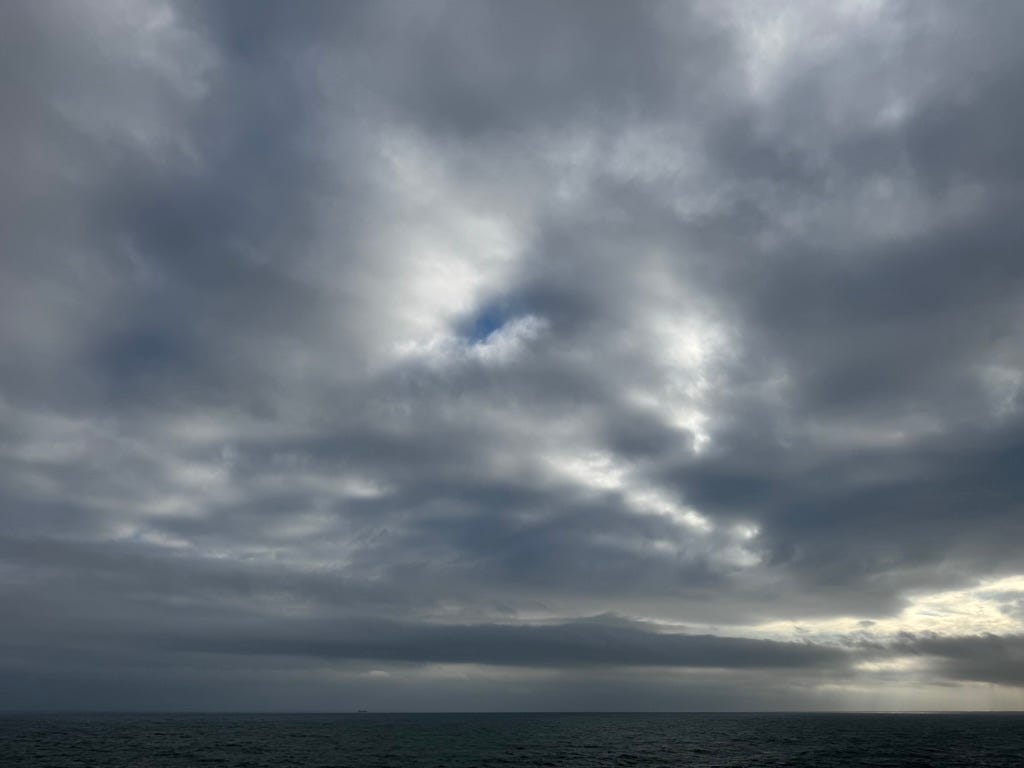
(Weather report ends.)
In a welcome distraction from the dismal goings on of 2026, I’ve recently taken part in Lindsay Johnstone’s brilliant flash memoir co-creation experiment The Chain.
Starting with a piece of life writing by Ingrid Fernandez, chosen by Lindsay from the final week of an earlier run of The Chain, a group of writers have gathered online each Sunday to respond to a prompt piece.
In each weekly session Lindsay has facilitated a discussion, giving us the opportunity to reflect on the prompt, before we embark on a 40 minute sprint responding to the prompt with a piece of flash memoir. At the end of each session there’s been the option to share with the group what we’ve written by posting our pieces in a closed space. Lindsay has then selected one piece each week for a light edit, before posting it the following Sunday as the new prompt, and so on.
I hadn’t shared any writing until I put my first post up on Substack a year ago. I signed up to The Chain to give myself a push, bolstered by all the positive comments from those who’d participated in the summer run. I’m so glad I took part and am grateful to Lindsay and everyone involved. This has been an inclusive, supportive and respectful space and it’s been fascinating to see how people respond so differently to every piece. I know Lindsay’s skilled facilitation and insightful comments have been appreciated by everyone taking part and I don’t think anyone wanted it to end.
Lindsay has shared some of the publicly posted responses on her Substack and I recommend having a look.
I wrote the piece below last week in a 40 minute sprint, responding to this beautiful prompt piece by Sasha Neal. I’ve done some light editing, mainly to remove a bunch of superfluous commas, which I’ve been far too liberal with in these sessions. No doubt a keen editor would remove more but I’ll leave it as it is without further tinkering.
I promise I don’t always write about death but this one does fall under that category, focusing on my mum’s final weeks in a hospice.
The Mother We Share
She comes to me in dreams. In the gentler ones we sit at her kitchen table, talking. She leans in, hands on the table, challenging me (gently) about decisions I’m making, keeping me on the right track in my waking hours; her wise counsel available to me in death as it was in life.
In the recurring dreams, the ones that haunt me, she’s somehow come back to life. I have the joy and relief of knowing she’s still here but understand that she’s dying and that we’ll have to go through the pain of losing her all over again. Is her resurrection worth it, only to go through the pain of her loss?
In August 2013, three decades after the car accident that left our mum paralysed, a melanoma that had originated on the sole of her foot in 2011 spread through her body and took up residence in her brain. She spent five weeks in a hospice, surrounded by my three sisters and me – ‘her girls’. Alongside the amazing nurses there, we tended to her needs, just as she’d tended to ours.
Seamus Heaney died during this time and I pored over tributes. The poem about his own mother dying struck me:
‘When all the others were away at Mass
I was all hers as we peeled potatoes…’
The intimacy captured in this and the lines that follow said everything about the bond between mother and child we’d been lucky to have with Mum. For all her many challenges she somehow had time for each of us, individually and together as a family unit. Each of her girls had shared everyday moments like this with her. We were all richer for it.
Mum’s strong body shrank quickly in those final weeks. Her skin became paper thin; she appeared suddenly elderly. In no time at all, she’d become wholly dependent on others; her worst fear. My sisters and I surrounded her with love and music – all her favourites: Cat Stevens, Joni Mitchell, Leonard Cohen, James Taylor.
She appeared to lose consciousness after a seizure, and we sat around her bed thinking this was the end. But she rallied and was with us a while longer. One day we helped her as she struggled to sit up in bed. She was looking directly at me. She hadn’t spoken for days but clearly wanted to say something.
Taking hold of my arm, she said, slowly:
‘Take the sound advice.’
These were her last words.
I was wayward, despite being the eldest. I can’t say for sure whether I’ve always taken on board this directive, but I know I’ve grown wiser since she died.
Her final few days felt like an event. We sat around her as if waiting for a child to be born, knowing the conclusion would be something quite different. A life force flowed through her like nothing I’ve seen before. Her chest heaved and she refused to die, despite having taken no food or fluid for days. Our favourite nurse, Euna, came in to check on her. She was the kindest person we could have wished to have there. Her head gently tilted to one side, she looked at mum then at us four girls:
‘She doesn’t want to leave you.’
It really felt like that.
The words of Dylan Thomas were in my head as we watched her dying. She raged, raged, against the dying of the light. It was intense, profound, and – when she eventually did die – devastating.
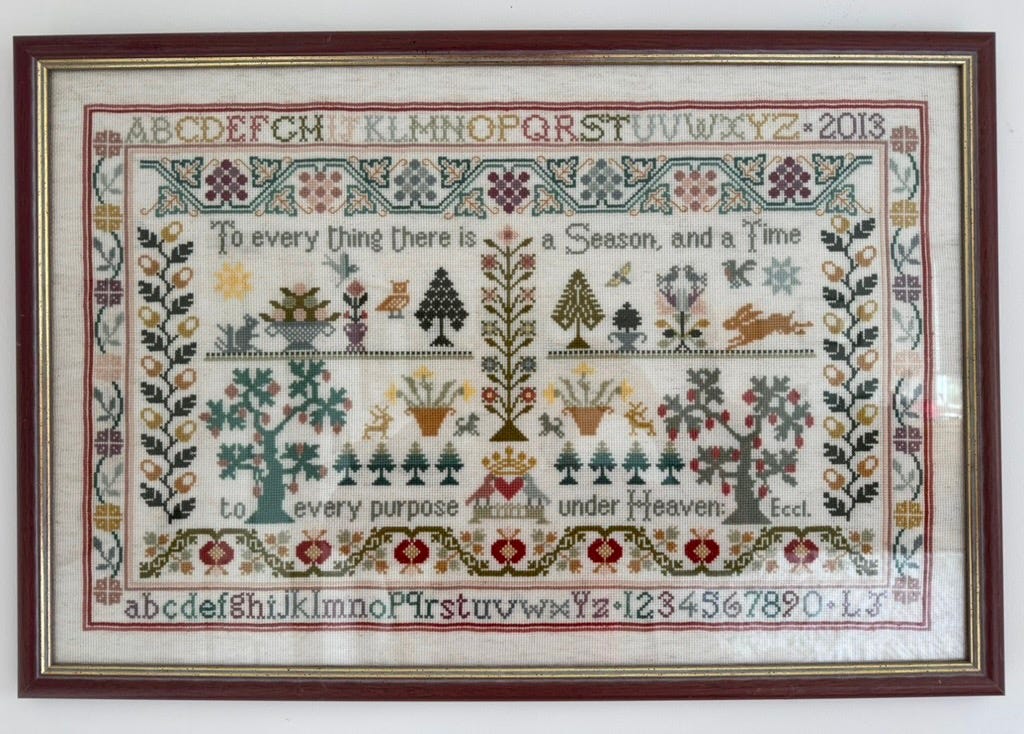
In the final year of her life, when she knew death was approaching, she cross-stitched a large sampler with numbers, letters, trees, birds and insects, and this passage from Ecclesiastes:
To every thing there is a Season,
and a Time to every purpose under Heaven.’
Mum was not religious, but her handiwork was intentional. She knew how the verse went on:
‘A time to be born, and a time to die.’
Mum knew it was her time to die and she accepted that, even though she didn’t want to leave us.
She’d started making another sampler, one for me. She wouldn’t let me see what she was working on, only saying she thought I’d appreciate the sentiment. But the brain metastases affected her vision and she barely got past the first few lines. After she died, one of her old school friends took it away for her sister to stitch, sending it to me framed a few months later.
The sampler sits above my desk as I write this. It features the chorus from Auld Lang Syne, and a quote:
‘Friendship is the wine of life.’
Mum is still with me, in my dreams and in my waking hours.
She’s with my sisters. I see her in their faces and in their hand gestures. I hear her soft voice in theirs.
The mother we share.
Seamus Heaney reading Sonnet 3 from Clearances, When all the others were away at Mass
Dylan Thomas reading Do Not Go Gentle Into That Good Night
This single by Chvrches came out the week Mum died and I’ve always found it comforting, whatever its true meaning. (I recognise it isn’t an anthem for siblings but it always makes me think of my sisters and our mum.) I love the dreamy synth pop chord progression in the chorus and Lauren Mayberry’s beautiful voice.
I intend to do another book post soon, and in the meantime I’d love to know what people have been enjoying lately. Any recommendations gratefully received.
Thanks for reading,
Sophie
“We sat around her as if waiting for a child to be born” - that description of the vigil at your mother’s bedside really resonated, Sophie. You’ve described the waiting, watching, the caring, the fragility and resilience so beautifully.
You made me cry Sophie. The connection between you and your mum sounds very special and you really moved me with your words.
Amazing that you have written that in such a short space of time. It was clearly ready to be expressed. X